
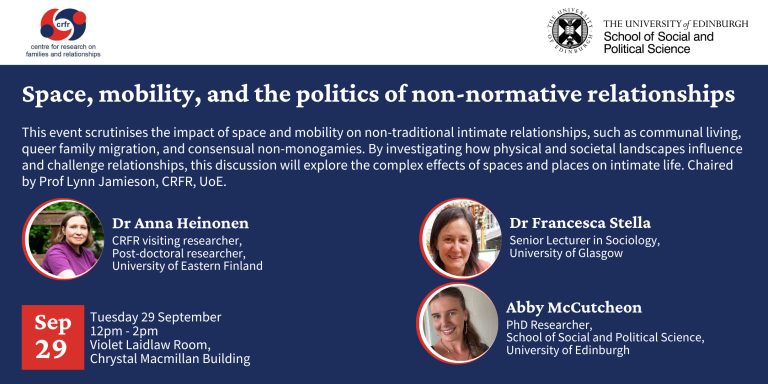
Space, mobility, and the politics of non-normative relationships
Tuesday 29 September
12pm – 2pm
Violet Laidlaw Room, Chrystal Macmillan Building
Venue: Violet Laidlaw Room, Chrystal Macmillan Building
Registration:
The event examines how spaces, places, and mobilities shape intimacies beyond the culturally established model of cohabiting heterosexual coupledom. Addressing communal living, queer family migration, and consensual non-monogamies, the event draws attention to the role of space and place in shaping intimate relationships that require considerable navigation from individuals due to their limited cultural and societal recognition. With a spatial perspective the event analyzes relational navigations across multiple scales, from bodily movement and sensory experience to the influence of spatial imaginaries, infrastructures, borders, migration, and material flows.
Panel Speakers:
Dr Anna Heinonen (Post-doctoral researcher, University of Eastern Finland, CRFR visiting researcher)
Spatial sexualities: Reorienting desire in Finnish communal living
This presentation explores how communal domestic spaces and relationships that do not follow culturally established, family-centered models of housing can steer sexuality in unforeseen directions. Drawing on 28 interviews and survey data from 121 Finnish communal dwellers, the presentation shows that domestic space brings communal dwellers into close contact with co-residents and material objects in ways that can influence and reorient their sexuality. At the same time, communal dwellers primarily define their mutual relationships as non-sexual, which requires them to continually manage developing orientations within communal spaces.
Although research has paid increasing attention to bodily proximity in communal living in recent years, sexuality has yet to be analyzed in detail as a dimension of communal intimacy. By examining various aspects of sexuality, from identity and desire to crushes and sensory connections, the presentation sheds light on the malleable and situational dimensions of sexuality, underlining the importance of spatial and relational positions.
Dr Francesca Stella (Senior Lecturer in Sociology, University of Glasgow)
Queer Family Migration in the Political Now: Comparative and Community Organisations Perspectives from Italy, Turkey and the UK
This paper explores the neglected intersection between queer and family migration, drawing on 17 interviews with LGBTQIA+ and migrant community organisations and immigration lawyers across the UK, Italy, and Turkey. Queer family migration remains under researched in the literature, as family migration scholarship generally focuses on heterosexual kinship while queer migration literature is typically centred on individual queer mobilities. Comparative and community perspectives are largely absent from the not extensive literature on queer family migration, which has so far privileged Global North destination countries and focused mainly on couples, neglecting other experiences of queer kinship.
This paper is based on a comparative research project that explored queer family migration to and from three European countries with very different legal landscapes around LGBTQIA+ rights and migration policies: the UK, Italy and Turkey. It generated novel empirical and conceptual insights on the (mis)recognition of queer family rights and the (in)visibility of queer migrant families in three very different socio-legal contexts. It explicitly aimed to produce knowledge that can strengthen intersectional solidarities and improve awareness of and support for queer migrant families.
At a time of global backlash against human rights, when traditional gender roles and the nuclear family are increasingly mobilised against queer and migrant communities, the paper asks how global dynamics impact grassroots organising, funding landscapes and support available for queer families navigating immigration regimes. We draw on queer temporality to explore the formation of alternative family formations and to chart unstable national and transnational chronologies of rights expansion and backlash.
Abby McCutcheon (PhD Researcher, sociology, School of Social and Political Science, University of Edinburgh)
The Spatial Politics of Consensual Non-Monogamies
This presentation explores how consensual non-monogamies (CNMs) are shaped by space, place, and social context. Drawing on in-depth interviews with 21 CNM participants and 11 psychotherapists/counsellors in the UK and what are currently known as the USA and Canada, it shows how factors such as race, religion, gender, migration, and place shape these relationships. Rather than a single, unified community, CNMs emerge as diverse and unevenly experienced forms of intimacy.
CRFR NEWS

ENTER A SEARCH TERM AND HIT RETURN
Do you have some news, or are you running an event that may be of interest to the CRFR Community?
Suggestions must be broadly connected with our focus on research on families and relationships. To recommend your news/event, please contact us.
