
_____________________________________________________________________________________________________________________________________________________________________
In June and July, I was thinking more about how children build connections within their communities. I attended many academic sessions held at the University of Edinburgh and the 5th International Sociological Association (ISA) Forum of Sociology in Rabat, Morocco, and found that there were many presentations on research involving children’s participation. I became especially interested in Children’s Geographies and Art Based Research (ABR) related to children because both seem to let us approach children’s perceptions and interpretations.
In this post, I would like to share an example from my own research that shows how a traditional folk event once provided an important opportunity for children to socialize.
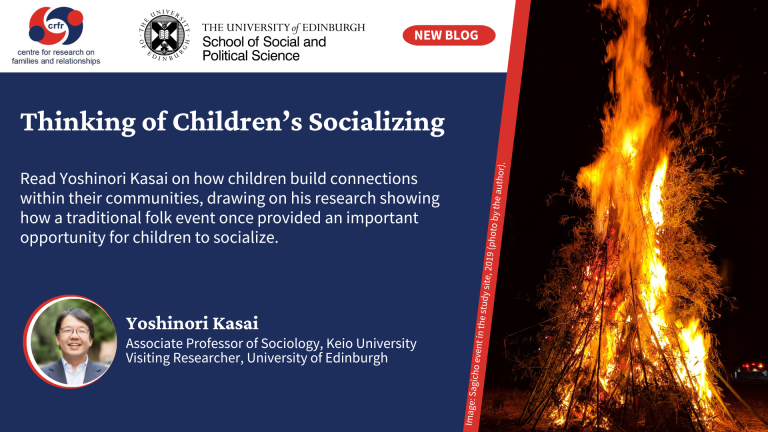
The first example is a folk event called by various names such as Sagicho (左義長) and Dondo (どんど), held in the New Year season throughout Japan. It is a local community event in which New Year’s decorations are collected and burned. It is said to have originated from palace rituals, and we can see a record of the original form in a 13th-century essay, Tsurezuregusa (徒然草). My interest, however, is not its origin, but the fact that it was, to some extent, an important opportunity for children to socialize within their local community.
As with most folk traditions, there are many variations on Sagicho but the activity at its core is the burning of the special decorations made to welcome in the New Year or the New Year’s deity. The fire takes place under a frame of bamboo on the eve of the first full moon of the New Year. The story is that the New Year’s deity returns to the celestial world in the smoke, their work and time on earth now over.
I have conducted a case study of a community which involved interviews with older people to understand how Sagicho was prepared and conducted. Sagicho needs bamboo trees for the main frame, rice straw piles as fuel, and wisteria vines as rope to set and fix the main frame. Soaked and softened vines can easily be connected and extended to match the required length, while being difficult to burn out. That is why they are ideal for fixing the frame. Before the 1960s, these items were provided by each household. Then people still had rice fields, especially in suburban and rural areas, although they had already begun to work in the secondary or tertiary industries. As farmers, or those who had rice fields, rice straw was easy to provide, and it was common to have a bamboo grove next to the house to make items for daily use. In addition, wisteria vines were easily found by digging riverbeds.
The role of collecting these items belonged to local children aged seven to twelve. During the school’s winter vacation, it was the children who collected bamboo and straw from each household. Households were conventionally required to provide one piece of bamboo from each man and one bundle of straw from each woman. A few days before the event, children dug up wisteria vines and soaked them in the river to soften them. The actual carrying out of the event on the day was the role of the Youth Group, consisting of unmarried boys aged thirteen and older.
The experience of that preparation was a form of secondary socialization. It created a special occasion for children to feel responsibility and autonomy among themselves. It was also the beginning of boys joining the age-ladder system in local communities. Children admired the Youth Group, which boys themselves would join someday.
As my monograph on Sagicho, Local Communities from a Case Study on a Folklore in Ritto City, Japan, showed through biographical interviews with elderly people and a questionnaire survey throughout the city, the drastic social changes in the past half century have greatly affected Sagicho as well as other folk events. The decreasing number of people with rice fields made it difficult to provide bamboo and straw. Paving the riverbanks made it impossible to dig wisteria there. Furthermore, children, or more precisely their parents, lost interest in engaging with local communities and in the age-ladder system because of diversified values and wider career options beyond the community.
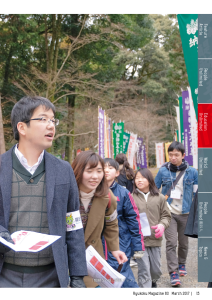
Fieldwork for “Gathering Sounds Along the School Route within a World Heritage Temple Site in Kyoto.” Photo originally published in Ryukoku Magazine No. 83 (March 2017).
Interestingly, some areas restarted Sagicho for children to enjoy watching the burning of decorations, even though they no longer participate in the preparation. I think many local communities have or had such a socializing opportunity for children, and I am curious how communities struggle to keep their relationships with children in recent years. How integrated are children in your community?
More recently I have held workshops with Japanese children about their own experiences: (1) “Hearing Life Histories of Probation Aides,” with junior high school students and (2) “Gathering Sounds Along the School Route within a World Heritage Temple Site in Kyoto,” by elementary school pupils. Both workshops enabled me to capture and share children’s unique perceptions, the latter fed into an exhibition at the temple. In addition, as a registered voluntary teacher of the city and a Kanji Educator (Kanji is one type of character in Japanese), I also held a Kanji Workshop for elementary school pupils, conducted by my eight-year-old daughter and undergraduate students. I would be happy to hear from readers about similar experiences in their own communities or projects with children – please email me at kasa@keio.jp.
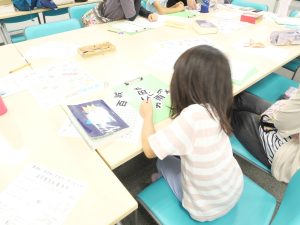
Children playing with original Kanji learning materials at the Kanji Workshop for elementary school pupils, held at the city hall in 2024 (photo by the author).